

Free ChatGPT Visibility Tracker
See if ChatGPT mentions your brand and where you rank in its answers.
- Free, no credit card.
- Report in minutes, link sent to your email.
What is ChatGPT visibility?
ChatGPT visibility is how often ChatGPT names your brand when people ask it for recommendations in your category, and how it describes you when it does.
Hundreds of millions of people ask ChatGPT for advice every week, and a growing share of those questions are about what to buy. The reply is a short list of brands with a reason for each, often with no link at all. There is no results page behind it to climb.
There is also no Search Console for ChatGPT. The only way to see your ChatGPT brand mentions is to ask the questions your buyers ask and read what comes back, many times over. A ChatGPT visibility tracker does exactly that. For the same view across every AI engine, day after day, there is the AI visibility tracker.
How the ChatGPT visibility tracker works
Nothing to install. No ChatGPT account, no API key.
- yourbrand.comCheck my brand1
Enter your domain
We read your site to learn what you make, who it is for and who else sells to the same people.
- what payroll tool should a small agency use
- compare payroll options for remote teams
- alternatives to payroll in spreadsheets
2We write the prompts
Ten prompts phrased the way people talk to ChatGPT: what should I use for, compare, alternatives to. Your brand is never named in them.
- what payroll tool should a small agency use
- compare payroll options for remote teams
- alternatives to payroll in spreadsheets
3ChatGPT answers
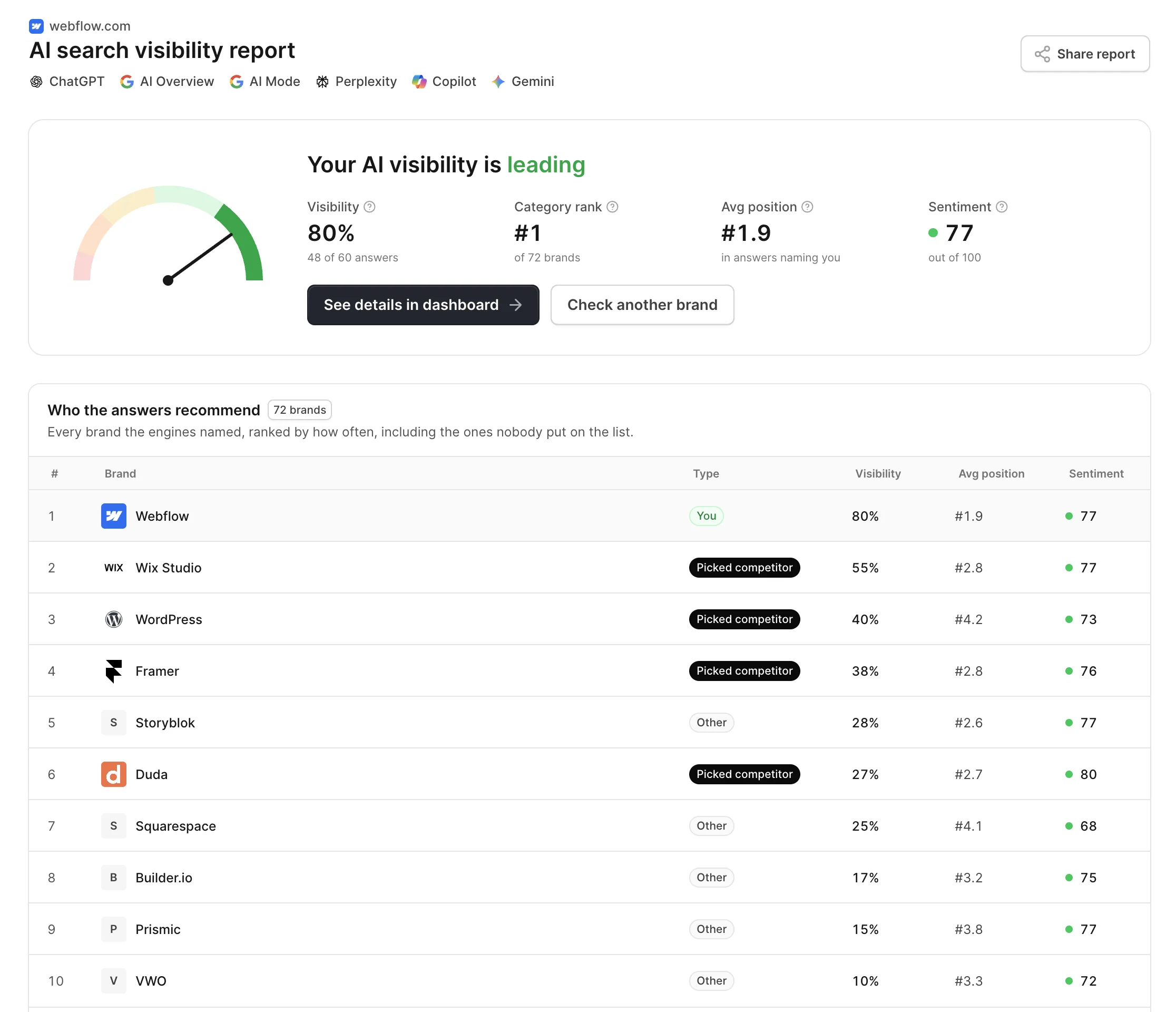
Each prompt runs on ChatGPT. We read the reply for the brands it recommends, their order, the tone and any links, then email you the report.
- Free, no credit card.
- Report in minutes, link sent to your email.
What the ChatGPT SEO checker shows
Six things you cannot see from a keyword report, read from ChatGPT's replies to your prompts.
Mention rate
The share of replies that recommend your brand. The single number that says whether ChatGPT knows you belong in the category.
Order in the list
Where you appear when you are recommended. ChatGPT tends to lead with the brands it is surest about.
How it describes you
The tone of each mention, from 0 to 100: recommended outright, listed with a caveat, or named as the option to avoid.
Who it recommends
Every brand ChatGPT puts on the shortlist instead of you, ranked by how often it came up.
Links it gives
The pages ChatGPT cited when it searched the web. Replies from the model's own knowledge may carry none.
Prompts you lose
The prompts where competitors were recommended and you were not, which is where to start.
Why ChatGPT brand monitoring is not rank tracking
ChatGPT does not return ten results for a keyword. What you measure changes with it.
Memory, not only the web
Many replies come from what the model learned in training, without a search. Your reputation in that data counts.
Conversations, not queries
Buyers narrow the list over a few turns. The brands that survive the follow-up questions are the ones that win.
Mentions, not clicks
A recommendation often carries no link. Being named is the result, whether or not anyone visits your site.
A share, not a snapshot
The same prompt returns different shortlists. How often you appear across replies matters more than one screenshot.
How ChatGPT decides which brands to recommend
ChatGPT draws on two sources: what the model learned during training, and, when it decides to search, the pages it finds on the web. Buying questions often trigger a search; broad ones are often answered from memory.
- What the model already knows
- Brands that were widely and consistently described before the model's training cutoff are names it reaches for without looking anything up.
- What ChatGPT search finds
- When it searches, OpenAI uses third-party search providers and its own crawler, OAI-SearchBot. Pages that bot cannot reach are not in the running.
- Agreement across sources
- It favors brands that many independent sources describe the same way — reviews, comparison articles, communities — over a single page's claims.
- Fit to the prompt
- Team size, budget, use case: ChatGPT matches brands to the constraints in the question. A clear, repeated statement of who you are for helps it match you.
How to rank in ChatGPT
There is no position to buy or optimize directly. There are the sources ChatGPT learns from and searches.
Start with the prompts you lose
The report shows which prompts recommend competitors and not you, and who takes your place in each.
Let OAI-SearchBot crawl you
Allow OAI-SearchBot in robots.txt so ChatGPT search can find your pages. GPTBot, the training crawler, is a separate choice.
Say who you are for, everywhere
Use the same one-line positioning on your site, your profiles and directory listings, so every source tells ChatGPT the same story.
Get into the lists it reads
Comparison articles, review sites and community threads that name your competitors are where a mention of you changes the shortlist.
Frequently asked questions
Enter your domain at the top of this page. The tracker writes ten prompts a buyer in your category would ask, runs them on ChatGPT and reports how often your brand is recommended, in what order and next to which competitors. Doing it by hand means asking the same questions in a clean chat many times and tallying the brands yourself.
In the sense that matters for ChatGPT, yes: it reports whether you are recommended and where you sit in the list, which is the closest thing ChatGPT has to a rank. It runs once rather than daily. To follow the same prompts every day, AskWatch tracks them on a schedule.
OpenAI says ChatGPT search draws on third-party search providers and on its own crawler, OAI-SearchBot, and Bing has been the provider associated with ChatGPT through its partnership with Microsoft. OpenAI has not said it uses Google results. Many replies involve no search at all and come from what the model learned in training.
ChatGPT writes each reply fresh, choosing words with some randomness, so two runs of the same prompt can produce different shortlists. Whether it searched, which model answered, and any memory or custom instructions on the account change it further. That is why visibility is measured as a share of replies, not from a single answer.
ChatGPT brand monitoring is watching how often ChatGPT mentions your brand, how it describes you and which competitors it recommends alongside or instead of you. This tool gives you that picture once, as a starting point; ongoing monitoring repeats the same prompts over time to catch changes.
Other free tools
- Open tool
AI Visibility Checker
Check if ChatGPT, Gemini, Perplexity and Google AI name your brand, and get your AI visibility score.
- Open tool
AI Overview Checker
See if Google AI Overviews cite your site, which of your pages they pick, and who is cited instead.
- Open tool
Perplexity Visibility Tracker
Track whether Perplexity cites your site and names your brand in its answers.
- Open tool
Gemini Visibility Tracker
Check if Google Gemini mentions your brand and who it names instead.
- Open tool
Google AI Mode Visibility Tracker
See if Google AI Mode names your brand and which pages it cites.
- Open tool
Copilot Visibility Tracker
See if Microsoft Copilot mentions your brand and cites your site.
- Open tool
Google Search Console MCP
Ask Search Console in plain language from Claude, ChatGPT, Cursor or Claude Code. No Google Cloud project.
Check your brand in ChatGPT for free
Enter your domain. Your report is ready in a few minutes.
- Free, no credit card.
- Report in minutes, link sent to your email.